

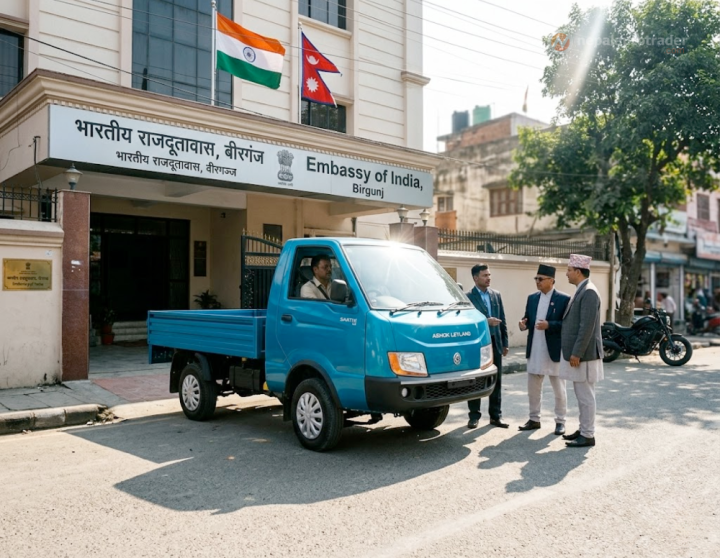
The hand‑over ceremony at the Indian Commercial Embassy in Birgunj was more than a paperwork exercise. Deputy Commercial Attaché Devi Sahaya Mina presented the trucks to Bhola Dahal, the chief district officer of Parsha. Thirty units left the embassy yard, each bearing a plate that reads वन‑टन – a nod to the 1,120 kg payload capacity.
Why does that matter? Nepal’s election commission faces a logistics nightmare: thousands of ballot boxes, voting machines, and security gear must travel from the plains to mountain villages. A single Sathi can replace three smaller vans, cutting fuel costs and road wear.
The Sathi is a pick‑up built on Ashok Leyland’s commercial platform. It debuted in India last year but has yet to reach Nepalese showrooms. The donation gives local operators a first look at a vehicle that could reshape the light‑truck market.
| Specification | Detail |
|---|---|
| Engine | 1.5 L turbo‑charged three‑cylinder diesel |
| Power | 45 hp @ 3,300 rpm |
| Torque | 110 Nm @ 1,000‑2,400 rpm |
| Payload | 1,120 kg (one‑ton class) |
| Loading Deck | 8.2 ft (2.5 m) flatbed |
| Fuel Tank | 40 L |
| Crew Cabin | Modern, high‑visibility dashboard |
A quick glance shows why the Sathi is suited for Nepal’s terrain: a compact wheelbase, decent ground clearance, and a diesel engine that thrives on low‑grade fuel.
That matters for the election commission, which must deliver ballot boxes to over 5,000 polling stations in a limited time window.
The transfer is part of a larger Indian assistance program. Since 2020, India has handed over 580+ vehicles – from Mahindra Bolero SUVs to Bajaj motorcycles – to support Nepal’s infrastructure and security needs.
| Phase | Date | Status |
|---|---|---|
| Initial aid | 2020‑2022 | Completed – 580+ vehicles delivered |
| Current hand‑over | 19 Falgun 2082 (Feb 2026) | 30 Sathi pickups transferred |
| Future deliveries | 2026‑2028 | Planned – additional medical and communication kits |
The timing aligns with Nepal’s general election slated for later in 2026. By bolstering transport capacity now, the commission hopes to avoid delays caused by monsoon‑damaged roads.
IME Motors, the official Ashok Leyland distributor in Nepal, says the Sathi could soon appear in showrooms. If the government’s trial proves successful, a civilian version may follow, targeting construction firms, agro‑businesses, and logistics operators.
That changes things for Nepal’s logistics sector, which has long depended on aging Japanese pickups.
Q: What is the exact payload capacity of the donated vehicle? A: The Ashok Leyland Sathi is rated for 1,120 kg, which places it in the one‑ton class.
Q: When will the Sathi become available for private buyers in Nepal? A: IME Motors has not set a launch date yet, but they expect to start taking orders once the election‑season trial concludes, likely in the second half of 2026.
Q: How does the Sathi compare to the Mahindra Bolero in terms of power? A: The Sathi’s 1.5 L turbo diesel delivers 45 hp, whereas the Bolero’s 1.5 L diesel typically produces around 75 hp. The Sathi focuses on payload efficiency rather than outright power.
Q: Are there any plans to import additional Sathi units beyond the 30 donated? A: Official statements mention only the 30 units for the election, but the positive feedback could prompt a larger import batch later.
Q: What kind of fuel does the Sathi use and how does it perform on Nepal’s high‑altitude roads? A: It runs on standard diesel (B10). The turbocharged engine maintains torque at altitude, making it suitable for hill‑top polling stations.
Q: Will the government provide maintenance support for the donated trucks? A: Yes. IME Motors will supply spare parts and service training as part of the donation agreement.
PREVIOUS NEWS

Nepal Auto-Trader is one-stop platform for all automotive needs. We provide unbiased and unparalleled news/reviews of all auto-motives being launched in Nepalese Auto-Industry. Find recent updates and price of bikes/cars, compare and review recently launched bikes/cars, buy/sell/trade reconditioned cars/bikes and all government news about changing rules and regulation, road safety by subscribing us.

Subscribe to our Newsletter
© Copyright 2026, Nepal Autotrader



.png)
.png)