

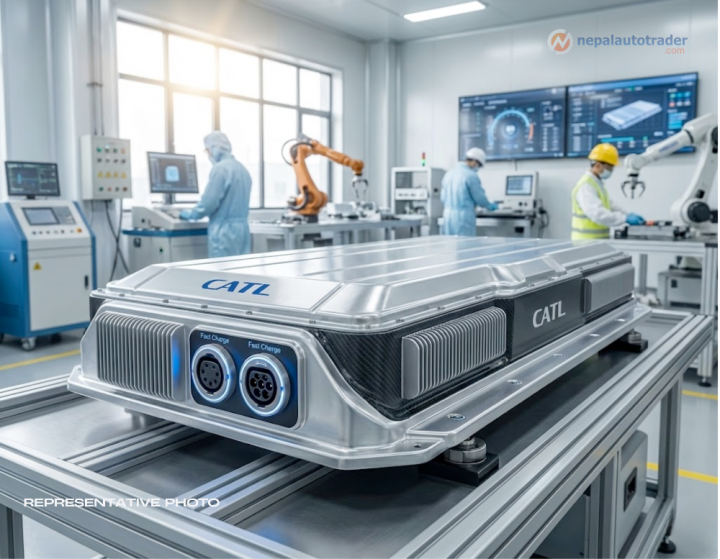
Chinese battery giant CATL released a technical brief this week claiming it has built the world’s fastest‑charging lithium‑ion cell. The company says the new pack can go from 0 % to 100 % in 12 minutes under laboratory conditions. The data was presented at a closed‑door symposium in Shanghai and later circulated to global partners. No prototype vehicle has yet been fitted, but the figures are striking compared with today’s typical 30‑ to 45‑minute fast‑charge sessions.
A 12‑minute charge window erodes the biggest psychological barrier to EV ownership – range anxiety compounded by long charging times. For Nepal’s growing fleet of electric taxis and delivery vans, a quick top‑up could mean near‑continuous operation, higher revenue per vehicle, and lower idle costs. That matters for policymakers pushing for cleaner air in Kathmandu, where traffic congestion already chokes the city.
The battery relies on two proprietary tricks:
Both features aim to preserve health during the aggressive charge profile. The company says the pack can survive ≈15 lakh miles of operation with ≈80 % of its original capacity still intact. That durability is critical because fast charging usually accelerates degradation.
| Metric | Claimed Value | Notes |
|---|---|---|
| Full‑charge time | 12 minutes | Lab test, 0‑100 % at 300 kW |
| Cycle life (15 lakh miles) | ≈80 % capacity retained | Based on accelerated ageing model |
| Thermal management | Smart‑cooling system | Adjusts flow rate per cell temperature |
| Self‑repair technology | Electrode micro‑crack healing | Reduces capacity fade |
Even without a commercial rollout date, the announcement ripples through the local market. Fleet operators, who currently factor charging downtime into their cost models, may soon be able to re‑schedule routes around a 12‑minute pit stop. That could push the total cost of ownership (TCO) of an electric van below that of a diesel counterpart within the next five years.
A quick‑charge battery also reshapes the charging‑infrastructure business case. Existing 50 kW and 150 kW stations would need upgrades to 300 kW+ to exploit the new pack’s potential. Investors might accelerate deployment of ultra‑fast chargers at highway rest areas, shopping malls, and major logistics hubs.
CATL has not announced when the battery will hit production lines. The company hints at a pilot phase within the next two to three years, targeting high‑usage fleets in China first. If the technology proves reliable, global OEMs could integrate it into upcoming models, and Nepal’s import pipelines would likely follow.
In the meantime, the industry watches for independent validation. Real‑world tests will need to confirm that the 12‑minute claim holds under varied temperatures, state‑of‑charge ranges, and driver habits. Until then, the news serves as a beacon for policymakers, investors, and consumers eager for a fast‑charge future.
Q: How realistic is the 12‑minute full‑charge claim?
A: The figure comes from CATL’s laboratory tests at a constant 300 kW charge rate. Independent road‑testing will be needed to verify performance under real‑world conditions.
Q: When might Nepal see vehicles equipped with this battery?
A: CATL suggests a pilot rollout within two to three years, initially for Chinese fleet operators. Importers could introduce compatible models shortly after, likely in the mid‑2020s.
Q: Will existing charging stations support the new battery?
A: Most current fast‑chargers (50‑150 kW) will be too slow. Upgrading to 300 kW or higher will be necessary to achieve the advertised 12‑minute charge.
Q: Does the fast‑charge capability affect battery warranty?
A: CATL claims its smart‑cooling and self‑repair systems preserve health, but OEMs may still set specific warranty terms that limit ultra‑fast charging cycles.
Q: How does the 15 lakh‑mile durability compare to today’s batteries?
A: Conventional EV batteries typically retain 70‑80 % capacity after 100 000‑150 000 km. The claimed 1.5 million km at ~80 % suggests a significant extension, pending real‑world validation.
Q: What impact could this have on EV pricing in Nepal?
A: Faster charging could lower the total cost of ownership, making EVs more attractive despite a potentially higher upfront price for the advanced pack.

Nepal Auto-Trader is one-stop platform for all automotive needs. We provide unbiased and unparalleled news/reviews of all auto-motives being launched in Nepalese Auto-Industry. Find recent updates and price of bikes/cars, compare and review recently launched bikes/cars, buy/sell/trade reconditioned cars/bikes and all government news about changing rules and regulation, road safety by subscribing us.

Subscribe to our Newsletter
© Copyright 2026, Nepal Autotrader



.png)
.png)