

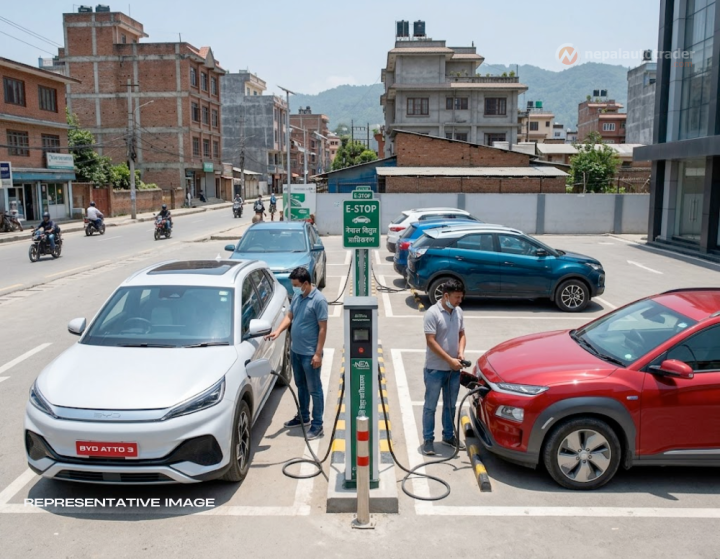
The Department of Transport Management, DOTM, has issued a clear instruction to electric vehicle charging operators, do not overcharge users. The message is simple, but the timing is critical. Nepal’s EV transition is accelerating, and with that comes friction, especially around pricing transparency.
Reports of inconsistent charging fees have been surfacing. Some stations reportedly charging beyond approved rates. Others applying unclear pricing structures. DOTM has now stepped in to draw a line. That matters.
This is not a casual advisory. It is a directive aimed at ensuring fair access to charging infrastructure, especially as EV ownership spreads beyond early adopters into the mainstream.
The instruction applies broadly across the EV ecosystem. From privately operated charging stations to institutional charging networks, everyone is expected to comply with government-approved pricing frameworks.
At its core, the directive emphasizes:
This is not about introducing new pricing. It is about enforcing what already exists. That distinction matters.
| Regulatory Focus | Requirement | Impact |
|---|---|---|
| Pricing Control | Follow approved EV charging rates | Prevents overcharging |
| Transparency | Clear billing for users | Builds consumer trust |
| Compliance | Adhere to DOTM instructions | Ensures uniformity across stations |
The scope is wide. And the tone suggests enforcement will follow if ignored.
Nepal’s EV market is no longer niche. Imports are rising, new models are entering, and charging stations are expanding across cities and highways. With that growth comes a predictable problem, pricing inconsistency.
Operators are working in a fast-evolving environment. Infrastructure costs vary. Electricity supply conditions differ. But for consumers, unpredictability in pricing creates hesitation.
The government sees the risk. If charging costs become unreliable, EV adoption slows. Confidence drops. That is not acceptable at this stage of transition. This changes things.
For context, related developments like the expansion of public charging networks covered in EV charging infrastructure in Nepal have already highlighted the importance of pricing stability.
For operators, this directive tightens the operating environment. Pricing flexibility narrows. Compliance becomes non-negotiable.
But it also brings clarity.
For EV owners, the benefits are immediate. Predictability. Fairness. Confidence.
Especially for new buyers considering models highlighted in BYD Atto 3 review or Tata Punch EV launch, charging cost clarity plays a decisive role.
It is not just about buying the vehicle. It is about living with it. Every day.
This directive is not isolated. It is part of a broader shift toward structured EV governance in Nepal.
As the market grows, informal practices give way to regulation. Pricing, safety, infrastructure standards, all moving toward consistency.
Consider the trajectory:
Nepal is now entering that third phase. Slowly, but clearly.
The message is unmistakable. Growth will continue, but under rules.
The immediate question is enforcement. DOTM has issued the instruction, but monitoring will determine its effectiveness.
Expect increased scrutiny on:
Operators may need to recalibrate pricing models. Some may absorb costs. Others may optimize operations. Either way, the era of unchecked pricing is ending.
For consumers, this is a signal of stability. For operators, a reminder of accountability.
And for the market, a necessary correction. Quiet, but significant.
Q: What did the Department of Transport Management instruct?
A: DOTM instructed EV charging stations not to overcharge users and to follow approved pricing standards. The focus is on fairness and transparency.
Q: Does this apply to all charging stations in Nepal?
A: Yes, the directive applies to both private and commercial EV charging operators, ensuring uniform compliance across the sector.
Q: Why is the government regulating EV charging prices now?
A: Rising complaints about inconsistent pricing and increasing EV adoption prompted the government to ensure fair and predictable charging costs.
Q: Will EV charging prices decrease after this directive?
A: The directive does not set new prices but enforces existing approved rates, preventing overcharging rather than reducing official tariffs.
Q: How does this affect EV buyers?
A: Buyers gain more confidence due to predictable charging costs, which improves the overall ownership experience.
Q: What happens if charging stations ignore the directive?
A: While enforcement details are not specified, non-compliance could lead to regulatory action as oversight increases.

Nepal Auto-Trader is one-stop platform for all automotive needs. We provide unbiased and unparalleled news/reviews of all auto-motives being launched in Nepalese Auto-Industry. Find recent updates and price of bikes/cars, compare and review recently launched bikes/cars, buy/sell/trade reconditioned cars/bikes and all government news about changing rules and regulation, road safety by subscribing us.

Subscribe to our Newsletter
© Copyright 2026, Nepal Autotrader



.png)
.png)