

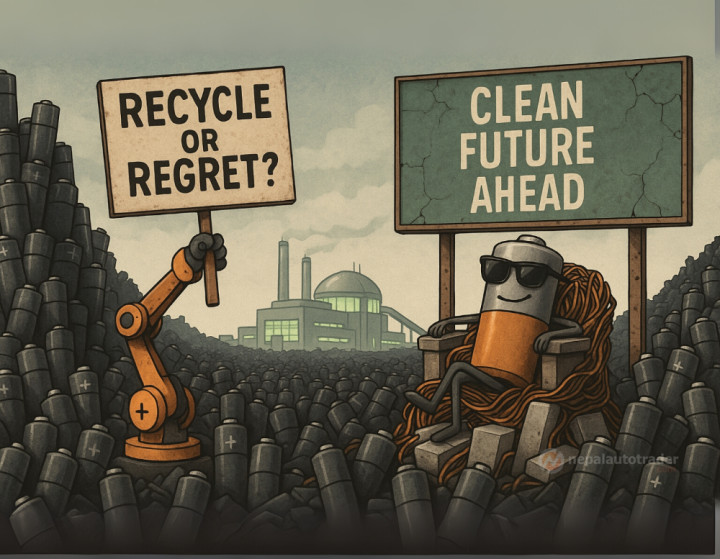
Only 5% of EV lithium-ion batteries are currently recycled worldwide.
Europe's automakers are launching pilot plants, robotic disassembly, and circular supply chains.
Urban mining will soon be more important than traditional mining.
Nepal must act early—before the EV boom turns into a battery waste crisis.
Let’s not sugarcoat it. We’re barrelling toward a future where millions of electric vehicle batteries will reach the end of the road—and there’s nowhere to put them. These aren’t your granddad’s car batteries. Lithium-ion cells are bulky, volatile, and expensive to throw away.
By 2030, the EU expects 30 million EVs on its roads. That’s a mountain of hazardous battery waste building under our feet. Most of it isn’t recycled. And if we don’t sort it now, we’ll be trading emissions for explosions.
Your average EV battery pack? Hundreds of densely packed cells, toxic chemicals, copper, cobalt, lithium, manganese—and one wrong move away from catching fire.
Currently, recycling means breaking them down manually, tossing the leftovers into a high-heat blender, and hoping we can extract enough black sludge—sorry, black mass—to make it worth the trouble.
The result? Wasted materials. Sky-high costs. And a process about as efficient as a steam engine in a supercar.
Automakers are waking up—and they’re getting their hands dirty. Here’s how Europe’s leading manufacturers are rewriting the recycling playbook:
VW’s pilot plant in Salzgitter can process up to 3,600 battery systems a year.
Focus: reclaiming cobalt, lithium, manganese, nickel, plus aluminium and copper for reuse.
All recovered metals go back into the production pipeline.
Teaming up with Veolia and Solvay, Renault’s recycling doesn’t stop at its own batteries.
Their goal: cover 25% of Europe’s EV battery recycling market, including production scrap.
Old Leaf batteries now power the automated guided vehicles inside Nissan’s own factories.
Reuse before recycle. Smart move.
Research institutions like the Faraday Institution and University of Birmingham are pioneering smarter ways to tear down EV packs:
Robotic disassembly: Safer, faster, and less error-prone than manual labor.
Selective extraction: Instead of black mass, isolate high-value metals directly.
Automation = Profitability: Cutting labor makes recycling financially viable in countries with high wages and strong safety laws.
Why dig new mines when old batteries are sitting right here? Europe doesn’t have massive lithium reserves. But it does have dead EVs—and that’s the motherlode.
Cobalt, lithium, and nickel aren’t infinite.
Urban mining gives us a closed-loop supply chain.
Circular economy = energy independence.
Nepal is on the brink of an electric vehicle boom. EV imports are climbing, government subsidies are encouraging adoption, and air pollution in Kathmandu is pushing consumers toward cleaner mobility.
But here’s the kicker: there’s no national framework for battery disposal or recycling.
Nepal must learn from Europe’s scramble:
Start regulating EV battery imports: Manufacturers and importers should have end-of-life responsibilities.
Plan a national take-back system: Don’t wait for batteries to pile up in garages and junkyards.
Incentivise local recycling startups: Make it lucrative to build robotic recycling plants now, not 10 years from now.
Partner with international firms: Leverage EU or Indian experience in early-stage tech transfer and pilot plants.
This isn’t optional. The longer Nepal waits, the messier—and more expensive—it gets.
Electric vehicles don’t end pollution. They shift it. From tailpipes to landfills.
If Europe wants to lead in clean mobility, it needs to own the entire lifecycle—from mine to motor to metal again. The same goes for any nation with EV dreams.
Recycling isn’t a bonus feature. It’s the chassis of a sustainable future. And whether you’re in Berlin or Bhaktapur, you better have a plan for your batteries—before they have a plan for you.

Nepal Auto-Trader is one-stop platform for all automotive needs. We provide unbiased and unparalleled news/reviews of all auto-motives being launched in Nepalese Auto-Industry. Find recent updates and price of bikes/cars, compare and review recently launched bikes/cars, buy/sell/trade reconditioned cars/bikes and all government news about changing rules and regulation, road safety by subscribing us.

Subscribe to our Newsletter
© Copyright 2026, Nepal Autotrader



.png)
.png)