

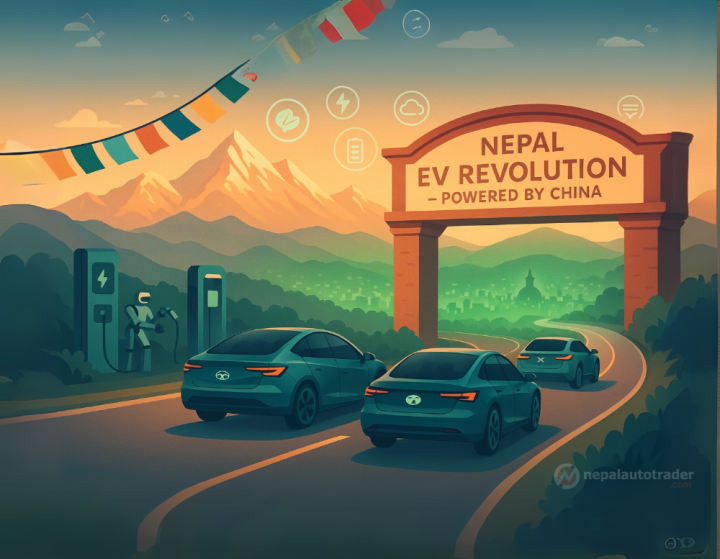
Chinese EV brands dominate Nepal’s auto market.
Air pollution solutions are accelerating adoption, especially in Kathmandu Valley.
Government incentives and improved infrastructure are fueling the EV boom.
Nepal’s geographic and economic alignment favors China’s electric mobility exports.
Battery-swapping and charging networks are being rapidly deployed.
The EV ecosystem is shaping up to be China's gateway to South Asia.
Electric vehicles are no longer a novelty in Nepal — they are a national movement. What started as a niche experiment has now become a dominant automotive paradigm. In the space of a few short years, Chinese EV manufacturers have reshaped Nepal’s entire mobility landscape.
Gone are the days of diesel-choked streets and long petrol queues. Kathmandu, once plagued by some of the worst air quality levels in South Asia, is seeing a silent yet powerful revolution. The sound of combustion engines is being replaced by the hum of electric motors — and leading this charge is China.
| Rank | Brand Name | Country of Origin | Market Share (Nepal, 2024) |
|---|---|---|---|
| 1 | BYD | China | 23% |
| 2 | Great Wall Motors (ORA, Haval) | China | 17% |
| 3 | MG (Owned by SAIC) | China | 13% |
| 4 | Tata Motors | India | 10% |
Chinese manufacturers, led by BYD, MG, and Great Wall Motors, have strategically captured Nepal’s EV market with a potent mix of affordability, innovation, and rapid delivery. Where Indian manufacturers hesitated, China moved fast — offering products tailored for Nepal’s terrain, pricing strategy, and charging ecosystem.
China’s EVs, particularly the BYD Atto 3, ORA Good Cat, and MG4, offer not only extended range and power but also SUV-like ground clearance — a critical factor in navigating Nepal’s rugged highways and unpredictable road conditions.
Most Chinese EVs offer premium features at budget pricing. Panoramic sunroofs, ADAS safety tech, and large infotainment systems come standard — features previously reserved for luxury brands.
The use of LFP (Lithium Iron Phosphate) batteries by Chinese automakers ensures longer life cycles, higher thermal stability, and faster charging, often with 8–10 years of warranty support.
Kathmandu routinely records PM2.5 levels above WHO safety limits, especially in winter months. The transport sector contributes nearly 40% of air pollutants in the capital alone. The electric mobility shift isn't just about trends — it’s about survival.
Nepal’s government has offered:
0% excise duty on EVs below 100kW
80% customs rebate
Loan subsidies and tax exemptions for individuals and companies investing in EV fleets
This results in a total cost of ownership (TCO) that is significantly lower than ICE vehicles.
The Nepalese government has been quick to recognize the momentum. Key policies supporting the EV ecosystem include:
National Action Plan for Electric Mobility (NAPEM): A roadmap targeting 25% electric vehicle penetration by 2025.
Incentives for local assembly and production, aiming to reduce import reliance.
Grants for charging infrastructure under the Alternative Energy Promotion Centre (AEPC).
Mandated EV fleets for government offices and transport corporations.
These policy interventions, while still maturing, show an undeniable political will to electrify.
Nepal sits at a geo-economic crossroads. With high-altitude borders open to Tibet and the Chinese mainland, logistics chains have been optimized by China to feed Nepal’s demand. Lhasa-based logistic firms now deliver EVs via land routes, cutting transit times and costs dramatically.
Moreover, China views Nepal as a testing ground for expanding EV infrastructure into South Asia. If successful, the same logistics and products can be replicated in Bangladesh, Bhutan, and beyond.
Nepal is in the midst of an infrastructure leap. Chinese companies like TGOOD, StarCharge, and Xpeng’s charging arms are actively partnering with Nepalese private and public stakeholders to roll out:
Fast DC charging stations (60–120kW)
Battery-swapping hubs for 2-wheelers and 3-wheelers
Home charging solutions bundled with EV purchases
Chinese EV dominance isn’t just about private cars. They’re transforming public mobility too. Skywell, Yinlong, and Dongfeng have supplied fleets of electric buses now running across Kathmandu’s city routes.
These buses:
Reduce emissions by 10 tons of CO₂ per year per unit.
Cut fuel and maintenance costs by 60%.
Provide safer, smoother, and quieter rides for commuters.
EV taxis and ride-sharing companies are also moving to 100% electric fleets, powered predominantly by Chinese brands.
| Metric | 2020 | 2024 | 2027 (Projected) |
|---|---|---|---|
| EV Market Share (%) | 1.3% | 34% | 58% |
| No. of EV Charging Points | 22 | 420+ | 1500+ |
| Chinese EV Share | 18% | 65% | 70% |
If this trend continues, Nepal will emerge as South Asia’s most EV-friendly country — and China its uncontested mobility partner.
What’s happening in Nepal is a masterclass in strategic market capture. Chinese EV brands, supported by soft diplomacy, infrastructure funding, and product-market fit, have turned Nepal into an electric mobility success story. India’s once-firm grip on Nepal’s automotive space has loosened, not just because China offered alternatives, but because it offered superior solutions.
This EV transformation is not only cleaning Nepal’s air and streets — it's realigning economic alliances, driving policy innovation, and setting the blueprint for EV adoption across South Asia.
Nepal has become the livewire in China’s electric future.

Nepal Auto-Trader is one-stop platform for all automotive needs. We provide unbiased and unparalleled news/reviews of all auto-motives being launched in Nepalese Auto-Industry. Find recent updates and price of bikes/cars, compare and review recently launched bikes/cars, buy/sell/trade reconditioned cars/bikes and all government news about changing rules and regulation, road safety by subscribing us.

Subscribe to our Newsletter
© Copyright 2026, Nepal Autotrader



.png)
.png)