

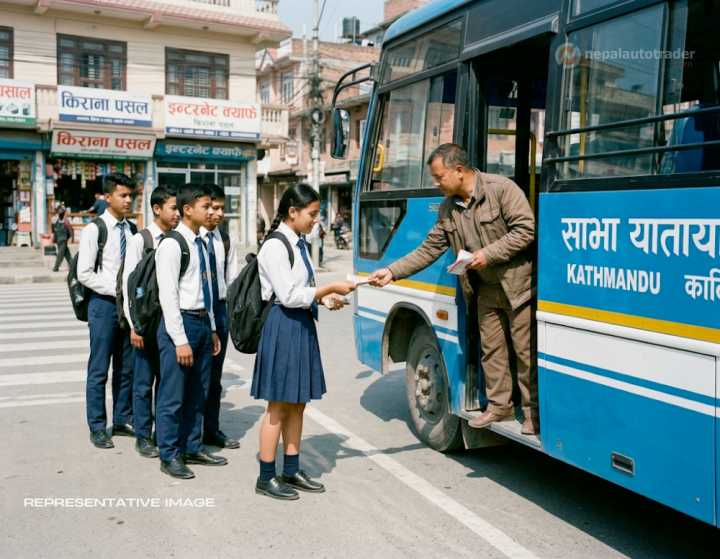
The message is no longer advisory. It is enforceable.
The concerned authorities have issued clear instructions to implement a mandatory 45% discount on public transport fares for students. This is not a new policy on paper, but what has changed is the tone. Enforcement has now taken center stage, with operators expected to comply without exceptions.
For years, the provision existed but lived in a grey zone. Students argued inconsistency, operators cited operational costs. That gap is now being closed. Strict implementation is the directive, and the wording leaves little room for interpretation.
That matters. Because in a fare-sensitive market, even small enforcement shifts ripple fast.
The instruction focuses on execution. Not policy creation, but policy compliance. Public transport operators have been directed to ensure that students receive a 45% fare concession upon presenting valid identification.
Key enforcement expectations include:
This is where friction historically lived, inconsistent application. Some routes honored the discount, others ignored it. Some drivers complied selectively. That inconsistency is now being targeted directly.
This changes things. Because uniform enforcement is where real impact begins.
On paper, it is a percentage. On the ground, it is daily survival math.
For students commuting across cities, transport costs stack quickly. The 45% reduction effectively cuts nearly half the burden, making education access more sustainable, especially for those traveling long distances.
The directive acknowledges a simple reality:
By pushing strict enforcement, authorities are not just regulating fares, they are reinforcing trust. When a policy is visible, predictable, and applied equally, it becomes real.
That matters. Because credibility in public systems is built on consistency, not announcements.
Transport operators now face a familiar tension. Policy compliance versus operational economics.
While the directive is clear, operators have historically raised concerns around fuel prices, maintenance costs, and revenue sustainability. A mandatory 45% fare cut for a large passenger segment directly affects margins.
Here is how the dynamics break down:
| Factor | Impact on Operators | Policy Position |
|---|---|---|
| Fare Reduction | Lower per-passenger revenue | Non-negotiable compliance |
| Student Volume | High ridership segment | Must be accommodated |
| Operational Costs | Rising fuel and maintenance | No direct adjustment stated |
This imbalance is not new. What is new is enforcement pressure. Operators may need to adapt through volume, efficiency, or internal restructuring rather than bypassing the rule.
This changes things. Because informal flexibility is being replaced with formal accountability.
Issuing a directive is one step. Enforcing it is another.
The focus now shifts to monitoring mechanisms. Authorities are expected to track compliance and respond to violations, particularly cases where students are denied the discount or charged incorrectly.
Potential enforcement actions may include:
While specific penalties were not detailed, the intent is clear, compliance is expected, not optional.
For students, this creates a window of accountability. For operators, it introduces a layer of scrutiny that has often been missing in fare regulation.
That matters. Because policy without enforcement is suggestion, and this is no longer a suggestion.
The directive fits into a broader narrative, gradual formalization of Nepal’s public transport system. Fare regulation, passenger rights, and service accountability are becoming more visible priorities.
Inconsistent fare practices have long been a friction point. This move signals a shift toward:
It is not a complete transformation. But it is a visible step.
And in a system where informal practices often dominate, even a single enforced rule can reset expectations. Slowly, then suddenly.
This changes things. Because once one rule sticks, others tend to follow.
Q: Is the 45% student discount now mandatory across all public transport?
A: Yes, authorities have instructed strict implementation of the 45% discount. Operators are expected to comply uniformly when valid student identification is presented.
Q: What documents are required for students to receive the discount?
A: Students must present a valid student ID card. The directive emphasizes proper verification by transport operators.
Q: Can transport operators refuse to provide the student discount?
A: No, refusal is not permitted under the directive. Operators are required to provide the discounted fare without exception.
Q: Will there be penalties for not following the rule?
A: While specific penalties were not detailed, enforcement actions are expected against non-compliant operators, including inspections and complaint-based action.
Q: Does the discount apply to all routes and regions?
A: The directive aims for uniform implementation, meaning the discount should apply across routes where public transport services operate.
Q: Why is the government enforcing this now?
A: The move addresses long-standing inconsistencies in fare application and aims to reduce financial burden on students while strengthening policy enforcement.

Nepal Auto-Trader is one-stop platform for all automotive needs. We provide unbiased and unparalleled news/reviews of all auto-motives being launched in Nepalese Auto-Industry. Find recent updates and price of bikes/cars, compare and review recently launched bikes/cars, buy/sell/trade reconditioned cars/bikes and all government news about changing rules and regulation, road safety by subscribing us.

Subscribe to our Newsletter
© Copyright 2026, Nepal Autotrader



.png)
.png)