

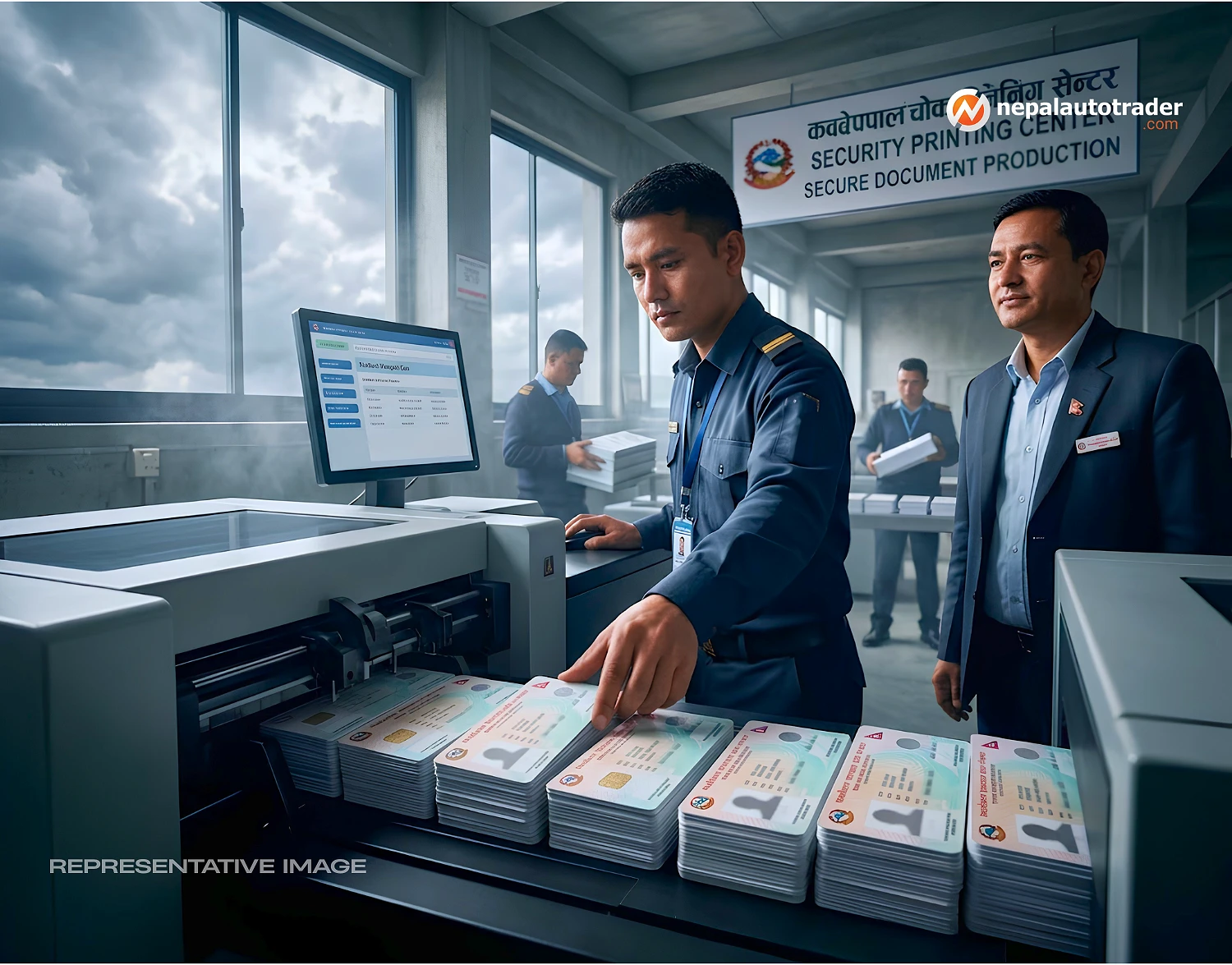
After years of watching driving-license production remain tied to the federal system, Madhesh Province has taken a practical step toward controlling the process for its own service users. The province has signed an agreement with the Security Printing Center and has started printing arrangements under the new provincial framework.
The change matters because license printing has long been one of the most visible bottlenecks in Nepal's transport services. Until now, the Department of Transport Management handled printing for applicants across all seven provinces before sending the cards to the relevant offices for distribution.
That centralized model put a large national workload through one federal process. For motorists waiting months or years for a physical card, the distinction between who manages transport services and who physically produces the license has been more than administrative. It has affected when people actually receive the document.
Now the responsibility is being pushed closer to the provinces. Yet there is an important detail that could easily be missed in the headline.
The phrase printing licenses itself sounds as though Madhesh has opened its own printing facility. It has not. The physical cards will be produced at the Security Printing Center in Kavrepalanchok under an agreement with the province.
In practical terms, Madhesh is taking responsibility for the printing arrangement rather than installing a complete security-printing operation inside the province. That distinction is significant, particularly because driving licenses are security-sensitive documents and the federal framework continues to shape where and how they can be produced.
| Part of the process | Current arrangement |
|---|---|
| Applicant data entry | Transport offices enter data into the central online system |
| Printing responsibility | Madhesh Province arranges printing for its service users |
| Physical printing | Security Printing Center in Kavrepalanchok |
| Data basis for printing | Daily data available through the central online system |
| Distribution to province | Printed licenses sent through the postal service |
For drivers, the most important point is simple. The administrative chain changes, while the physical production location remains centralized.
This is not a complete break from the federal transport technology infrastructure. According to Department of Transport Management information officer and director Keshav Khatiwada, data entered by transport offices across the country will remain available through the department's central online system. The Security Printing Center will use the daily data received through that system to print licenses and dispatch them to the respective provincial offices.
That creates a hybrid model. Responsibility moves outward, but the underlying data flow remains centralized.
It may sound like a technical footnote. It is not. A printing system can move closer to the province without forcing the entire licensing database, personalization process and transport-office workflow to be rebuilt from scratch. That lowers the disruption involved in changing the system while giving provincial governments more control over delivery.
The move also keeps one national source of applicant information in place. That matters for consistency as more provinces begin making their own arrangements.
Nepal's driving-license delays have become a familiar frustration for motorists. A previous Meroauto report said more than 3 million licenses were pending for printing, including applications from people who had passed trials or applied for renewal over the preceding four years.
The federal government has also been using the Security Printing Center to increase production capacity. In another phase of the rollout, the center agreed to print 1.2 million licenses within six months, with an initial operating rate of about 500 cards per day before the personalized printing software was fully available.
Madhesh's new arrangement sits inside that wider transition. Rather than expecting a single federal process to serve every province in exactly the same way, provinces can now organize printing for their own applicants while using the existing national data infrastructure.
The consumer benefit, assuming execution keeps pace, is obvious: fewer layers between a completed application and the delivery of a physical license. But the bigger issue lies elsewhere. Decentralizing responsibility only improves service when the printing queue, data transfer and distribution network actually move faster.
Madhesh is the first province identified in the latest report to have completed the agreement and begun the process. Other provinces are preparing similar agreements with the Security Printing Center, according to the Department of Transport Management.
That makes this more than a single provincial administrative change. It is an early sign of a broader restructuring of license production in Nepal.
Earlier preparations across the provinces show how persistent the pressure has been. Meroauto reported that several provincial governments had already allocated budgets or started planning for provincial license printing after delays under the centralized system. Provincial license printing plans had been discussed as a way to reduce the burden created by centralized production.
Bagmati Province, for example, had gone further by purchasing five printers as part of its own printing plan, although its rollout subsequently faced legal and regulatory obstacles linked to the security-printing framework. Bagmati's license printing preparations illustrate just how complicated the transition can become when equipment, software and legal authority do not move at the same speed.
The competitive context here is not between automotive brands. It is between public-service systems. Provinces that can turn administrative authority into faster delivery will have a clear advantage in the eyes of motorists.
The immediate next step is execution. Madhesh has signed its agreement and started the printing process. Other provinces are expected to work through their own agreements with the Security Printing Center.
The operating sequence is already clear:
What changes over time will be the scale and efficiency of this process. The more provinces that adopt the model, the more important coordination will become, especially around data accuracy, printing queues and delivery schedules.
For drivers, that is the part to watch. The announcement itself is administrative. The real measure will be whether a provincial applicant who completes the required process can receive the physical license sooner than before.
Madhesh has now put that model into motion. The next test is whether the rest of the system can keep up.
Q: Has Madhesh Province started printing driving licenses inside the province?
A: No. Madhesh Province has taken responsibility for arranging printing, but the physical licenses will be printed at the Security Printing Center in Kavrepalanchok under an agreement with the province.
Q: When did the new provincial license printing arrangement begin?
A: The Department of Transport Management said the new arrangement took effect from Bhadra 2083, with provincial ministries responsible for arranging license printing and distribution for their service users.
Q: Will transport-license data still be handled through the federal system?
A: Yes. Data entered by transport offices will remain available through the department's central online system, and daily data will be used for printing.
Q: How will Madhesh receive the printed driving licenses?
A: The printed cards will be sent from the Security Printing Center to the relevant provincial offices through the postal service.
Q: Are other provinces planning to print licenses under the same model?
A: Yes. The Department of Transport Management said other provinces are preparing agreements with the Security Printing Center so they can arrange printing for their own service users.
Q: Will provincial printing automatically eliminate driving-license delays?
A: Not automatically. The new model can reduce dependence on a single centralized arrangement, but faster delivery will still depend on data processing, printing capacity and distribution efficiency.

Nepal Auto-Trader is one-stop platform for all automotive needs. We provide unbiased and unparalleled news/reviews of all auto-motives being launched in Nepalese Auto-Industry. Find recent updates and price of bikes/cars, compare and review recently launched bikes/cars, buy/sell/trade reconditioned cars/bikes and all government news about changing rules and regulation, road safety by subscribing us.

Subscribe to our Newsletter
© Copyright 2026, Nepal Autotrader



.png)
.png)