

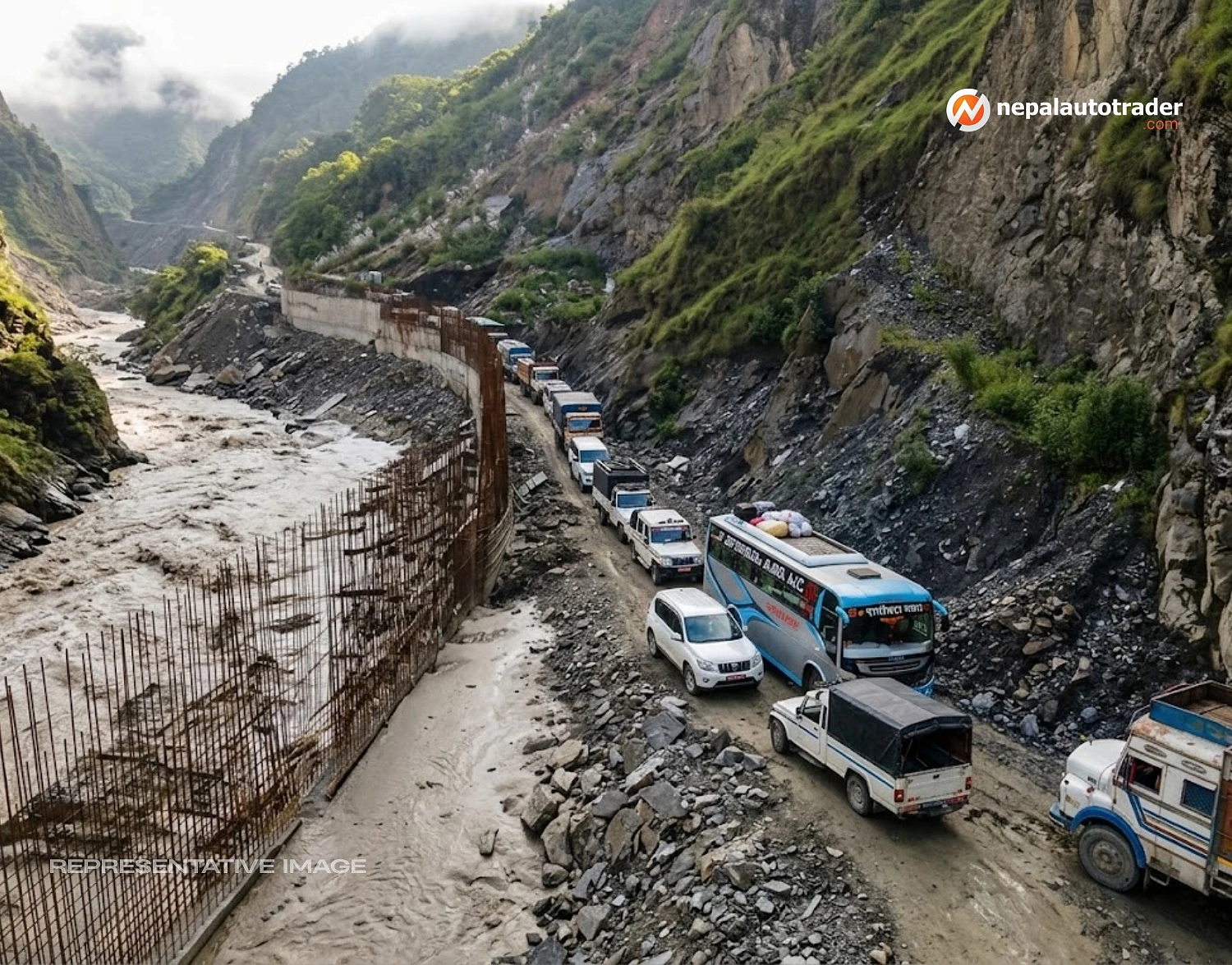
For motorists travelling between Kathmandu and eastern Nepal, the BP Highway is more than a convenient road. It is an important connection for families, businesses, public transport operators and people who depend on timely journeys between the capital and the eastern districts.
Its latest recovery follows another period of disruption caused by heavy rainfall, flooding and landslides. Traffic resumed after temporary repairs and diversions made it possible for vehicles to pass through damaged sections.
The reopening offered immediate relief. Yet an open road and a reliable road are two very different things, especially in Nepal's monsoon season.
The highway has suffered repeated damage from floodwater and unstable slopes. Each disruption brings a familiar set of problems, including delays, difficult driving conditions and uncertainty for people who have to travel regardless of the weather.
For drivers, the immediate question is whether the route is passable. For the authorities responsible for it, the harder task is keeping it that way.
Flooding and landslides have repeatedly affected the highway, particularly sections in Kavre and Sindhuli. In October 2024, severe flooding washed away or damaged substantial stretches of the road, forcing authorities to create alternative routes so traffic could resume.
Another round of heavy rainfall in September 2025 damaged the highway at several locations. Temporary repair work included building a diversion at Roshikhola, levelling riverbeds and filling potholes. These measures allowed vehicles to move again while the affected sections remained in need of further work.
The difference between restoring traffic and rebuilding the highway matters. Temporary routes can provide a lifeline, but they may also leave motorists facing rough surfaces, narrow passages and delays when conditions deteriorate.
| Development | Reported details |
|---|---|
| Road disruption | Flooding and landslides damaged sections of the BP Highway. |
| Traffic restoration | Temporary diversions and repair work allowed vehicles to pass. |
| Repair measures | Riverbed levelling, pothole filling and diversion construction. |
| Outstanding concern | Keeping traffic moving during further heavy rainfall. |
These are practical repairs, not a guarantee against another closure. When a road runs through a flood-prone landscape, the condition of its temporary sections can change quickly.
When a major road closes, the impact extends well beyond the people caught in traffic. Passenger transport operators may face disrupted schedules, businesses can experience delays, and families travelling between districts may have to reconsider their plans.
The BP Highway is particularly important because it offers a route between Kathmandu and eastern Nepal. When sections become impassable, drivers have to assess alternative routes, journey times and road conditions rather than simply following their usual travel plan.
That uncertainty also affects commercial vehicles. A delivery that depends on a predictable arrival time becomes harder to organise when a temporary diversion can be affected by rain or traffic congestion.
Motorists should pay attention to three things before setting out:
Two-wheelers and smaller cars can be especially uncomfortable on rough surfaces, while vehicles carrying passengers or cargo need enough room and control to negotiate uneven sections safely.
No driver should assume that a reopened road has returned to its normal condition.
The repeated damage to the BP Highway points to a broader infrastructure challenge. Emergency repairs are essential because communities cannot remain disconnected indefinitely. But rebuilding the road to withstand future flooding requires a different level of planning and construction.
That work involves more than laying a fresh surface. Drainage, embankment protection, stable slopes and structures that can cope with water flow all matter. Without them, a repaired section may be exposed to the same forces that damaged it previously.
Reporting by The Kathmandu Post on BP Highway reconstruction described continuing work on embankments and slope protection, alongside the use of temporary flood-resilient measures. The report also noted that permanent construction was progressing in several sections.
The reconstruction challenge is substantial because traffic must keep moving while work continues. Authorities have to balance access for motorists with the need to complete construction safely, particularly when monsoon rain threatens to undermine temporary arrangements.
There is a clear trade-off. Keeping a road open provides immediate economic and social benefits, but allowing traffic through unfinished sections can complicate construction and expose road users to changing conditions.
The immediate priority is to maintain safe vehicle movement wherever road conditions permit. Longer-term progress will depend on the pace of reconstruction, the stability of repaired sections and how effectively drainage and flood protection are built into the road.
Motorists should check the latest official traffic updates before departure, particularly during periods of rain. An earlier report that a route has reopened should not be treated as confirmation that every section remains clear later in the day.
Drivers should also allow flexibility in their travel plans. If water is flowing across a road, a diversion is visibly damaged or officials have restricted movement, attempting to force a crossing is not worth the risk.
The BP Highway's return to service is welcome news for people who rely on the route. Still, its repeated disruption is a reminder that reopening a road is only the first step. The real measure of success will be whether travellers can depend on it when the next spell of heavy rain arrives.
Q: Is the BP Highway open to vehicles?
A: Traffic has resumed on the highway following temporary repairs and diversions at damaged sections. Conditions and restrictions can change, so motorists should confirm the latest official update before travelling.
Q: Why was the BP Highway damaged?
A: Heavy rainfall, flooding and landslides damaged sections of the highway. The resulting disruption required temporary routes and repair work to restore vehicle movement.
Q: Which areas were affected by the highway damage?
A: Reports have identified damaged locations across Kavre and Sindhuli. The precise condition of individual sections can change as repairs and reconstruction progress.
Q: Is the temporary track the same as a fully reconstructed road?
A: No. Temporary diversions help restore traffic, but they may have rough surfaces and remain vulnerable to rainfall. Permanent reconstruction aims to provide a more durable route.
Q: What should drivers check before travelling on the BP Highway?
A: Check current traffic restrictions, weather forecasts and road-condition updates. Inspect your vehicle before departure and never attempt to cross floodwater or a section that authorities have closed.
Q: When will all damaged sections be permanently repaired?
A: A confirmed completion date for every affected section is not established by the source material available for this report. Reconstruction timelines depend on the individual sections and the conditions under which work can proceed.

Nepal Auto-Trader is one-stop platform for all automotive needs. We provide unbiased and unparalleled news/reviews of all auto-motives being launched in Nepalese Auto-Industry. Find recent updates and price of bikes/cars, compare and review recently launched bikes/cars, buy/sell/trade reconditioned cars/bikes and all government news about changing rules and regulation, road safety by subscribing us.

Subscribe to our Newsletter
© Copyright 2026, Nepal Autotrader



.png)
.png)