

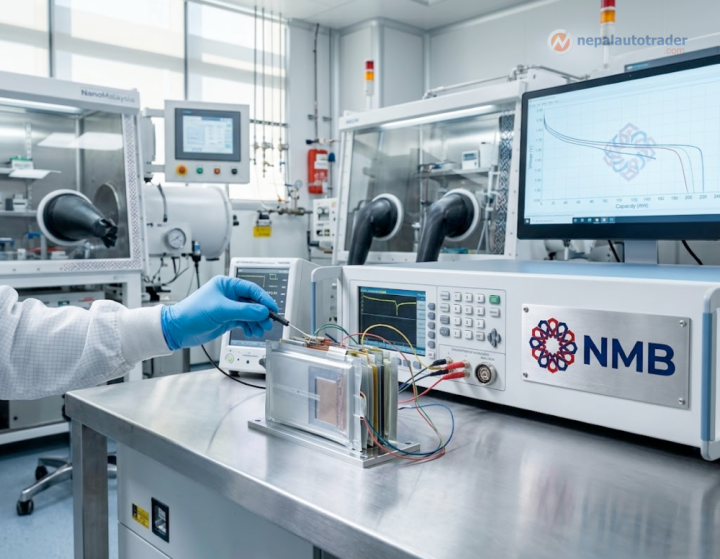
On a brisk morning in Kuala Lumpur, NanoMalaysia Berhad lifted the veil on a sodium‑ion battery prototype that clocks more than 300 Wh/kg. The figure is not a marketing flourish; it is a measured laboratory result verified by the agency’s internal testing labs. The achievement lands the prototype in the same performance tier as many mainstream lithium‑ion cells, yet the chemistry promises lower raw‑material cost and a safer thermal profile.
The prototype is still a bench‑scale unit, not a production‑ready pack. That matters because the path from lab to factory will involve redesigning cell geometry, optimizing electrolyte formulations, and proving long‑term cycle life. Still, crossing the 300 Wh/kg threshold signals that sodium‑ion chemistry is no longer a niche curiosity.
Energy density is the yardstick that determines how much power a battery can store per kilogram. At 300 Wh/kg, a sodium‑ion pack can power an electric vehicle for roughly the same range as a comparable lithium‑ion pack, but with a raw‑material bill that can be 30 % lower. The cost advantage stems from sodium’s abundance—salt is everywhere—while lithium mining is geographically constrained and environmentally contentious.
Safety is another lever. Sodium‑ion cells operate at a lower voltage window, reducing the risk of thermal runaway. For grid‑scale storage, where large banks sit for years, that safety margin translates into lower insurance premiums and simpler fire‑suppression designs.
Material sustainability cannot be overstated. The shift from cobalt‑heavy lithium chemistries to sodium reduces reliance on conflict minerals and lessens the ecological footprint of mining operations. In a world where ESG metrics drive investment, those attributes could tip the scales for industrial off‑takers weighing long‑term contracts.
The prototype emerged from a collaborative framework known as NESTI, a joint effort between NanoMalaysia, MOSTI, and the International Battery Centre Sdn Bhd. The partnership pooled research talent, test facilities, and funding streams to accelerate development.
| Development Phase | Date | Status / Details |
|---|---|---|
| Concept Validation | Q2 2024 | Bench‑scale cells demonstrated >250 Wh/kg |
| Material Optimization | Q4 2024 | Electrolyte and cathode formulations refined |
| Prototype Assembly | Q1 2026 | Full‑cell built, reached >300 Wh/kg |
| Performance Testing | Mar 2026 | Cycle life, safety, and thermal tests completed |
The cell architecture uses a layered cathode of sodium‑rich Prussian blue analogue, paired with a hard‑carbon anode. The electrolyte is a sodium‑based organic solvent blend, engineered to suppress dendrite formation. Each component was iterated through computational modelling before physical trials, cutting development time by roughly 20 %.
Reactions from the regional battery community have been swift. Analysts at BloombergNEF flagged the breakthrough as “a credible challenge to lithium‑ion dominance in stationary storage,” while local manufacturers see an opportunity to diversify supply chains.
Rezal Khairi Ahmad emphasized that the prototype is a stepping stone, not an end‑point. “Establishing multiple partnerships with industrial off‑takers will be crucial in the next steps to advance the technology readiness level and safeguard the interests of both local and international investors,” he said. The call for partners is explicit; NMB is already in talks with a Malaysia‑based data‑center operator and a Singaporean renewable‑energy firm.
The roadmap outlines three near‑term milestones:
These targets hinge on securing funding, finalizing supply contracts for sodium salts, and passing regulatory safety certifications.
Globally, the battery market is projected to exceed 1,200 GWh of annual capacity by 2030. Sodium‑ion’s share is still under 2 %, but analysts predict a CAGR of 15 % through 2035 if cost and safety advantages hold.
Malaysia’s strategic positioning—low‑cost electricity, skilled engineering workforce, and supportive MOST policies—could make it a hub for sodium‑ion production. If NMB can transition from prototype to volume manufacturing, the country may attract foreign direct investment from automakers and renewable‑energy developers seeking a diversified battery supply.
The breakthrough also nudges the broader conversation about battery material independence. Nations that rely heavily on imported lithium may look to sodium‑ion as a geopolitical hedge. That shift could reshape trade flows and spur new standards for grid‑scale storage.
The sodium‑ion story is still in its early chapters, but crossing the 300 Wh/kg line is a narrative pivot. Expect more announcements, pilot projects, and perhaps the first commercial sodium‑ion storage farms within the next few years.
Q: What is the exact energy density achieved by the NanoMalaysia prototype? A: The prototype recorded an energy density exceeding 300 Wh/kg, a figure verified by internal testing at NanoMalaysia.
Q: When will the sodium‑ion technology be available for commercial use? A: NanoMalaysia targets a kilowatt‑hour module by Q4 2027, a pilot manufacturing line by mid‑2028, and commercial deliveries beginning early 2029.
Q: How does the cost of sodium‑ion compare to lithium‑ion? A: While exact pricing is not disclosed, sodium‑ion cells are projected to be around 30 % cheaper in raw‑material costs because sodium is far more abundant than lithium.
Q: Which industries are likely early adopters of this technology? A: Industrial off‑takers such as data‑center operators, renewable‑energy firms, and grid‑storage providers are being approached for pilot projects.
Q: Are there safety advantages over lithium‑ion batteries? A: Yes, sodium‑ion cells operate at a lower voltage window, reducing the risk of thermal runaway and simplifying fire‑suppression requirements.
Q: Will this technology impact electric‑vehicle (EV) markets? A: Sodium‑ion’s comparable energy density makes it a potential EV candidate, but scaling to automotive‑grade volumes and meeting stringent cycle‑life standards will take additional years.

Nepal Auto-Trader is one-stop platform for all automotive needs. We provide unbiased and unparalleled news/reviews of all auto-motives being launched in Nepalese Auto-Industry. Find recent updates and price of bikes/cars, compare and review recently launched bikes/cars, buy/sell/trade reconditioned cars/bikes and all government news about changing rules and regulation, road safety by subscribing us.

Subscribe to our Newsletter
© Copyright 2026, Nepal Autotrader



.png)
.png)