

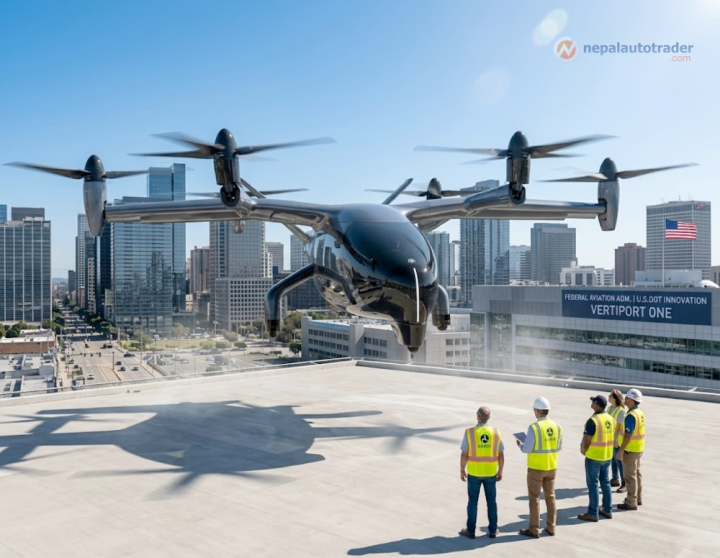
The U.S. Department of Transportation released a statement this week that the nation’s first commercial flying cars will be allowed to lift off in June. The move follows years of lobbying by the eVTOL industry and a series of safety studies that convinced regulators the technology is ready for limited exposure. The announcement was covered by Wired, which confirmed the timeline and the eight chosen regions.
The pilot is not a blanket waiver. Each aircraft must already be in the FAA certification pipeline, and the program will collect data on noise, emissions, and public perception. That matters because the data will shape the next round of federal rules.
Eight corridors were selected for the test. They span the East Coast, the Southwest, and the Mountain West, giving the program geographic diversity and a chance to compare urban versus suburban operations.
| Region | Key City | Participating Companies |
|---|---|---|
| New York | New York City | Archer Aviation, Joby Aviation |
| New Jersey | Newark | Beta Technologies |
| Texas | Austin | Archer Aviation, Electra |
| Florida | Miami | Joby Aviation, Beta Technologies |
| Albuquerque | Albuquerque, New Mexico | Electra |
| Colorado | Denver | Beta Technologies |
| California | Los Angeles | Archer Aviation |
| Washington | Seattle | Joby Aviation |
The spread lets manufacturers test everything from dense city cores to sprawling suburbs. It also gives regulators a cross‑section of airspace challenges.
When Adam Goldstein, CEO of Archer Aviation, called the pilot ""our Waymo moment,"" he was signaling a cultural shift. The company envisions hundreds of thousands of daily commuters gliding between downtown towers and regional airports, much like a rideshare fleet but three dimensions up.
Key selling points that keep investors excited:
If those claims hold, the eVTOL market could leapfrog conventional aviation and become a mainstream commuting option. That changes things for urban planners, who will have to rethink zoning for vertiports.
The pilot groups ultralight aircraft with eVTOL models, but all participants must be actively pursuing FAA certification. The agency will monitor four core metrics:
Data will be reported monthly to a joint task force that includes the DOT, the FAA, and industry representatives. The task force will issue interim guidance, but no aircraft will carry fare‑paying passengers until full certification is granted.
| Metric | Target | Measurement Method |
|---|---|---|
| Noise | ≤ 65 dB at 500 ft | Ground‑based sound meters |
| Cost | $3‑$4 per passenger mile | Operator financial reporting |
| Emissions | Zero tailpipe CO₂ | Electric powertrain monitoring |
| Safety | No serious incidents | Flight data recorder analysis |
The structured approach gives regulators confidence while allowing manufacturers to iterate quickly. It also creates a public‑facing narrative that the technology is being vetted, not rushed.
The pilot runs for three years. If the data meets or exceeds targets, the DOT has pledged to fast‑track broader airspace integration, potentially opening vertiports in major metros by 2029. Companies are already scouting sites near hospitals, office campuses, and transit hubs.
Meanwhile, investors are watching the pricing model closely. A simple table shows how the $3‑$4 per passenger mile estimate translates to typical trips:
| Trip Length | Estimated Cost | Typical Use Case |
|---|---|---|
| 8‑10 miles | $24‑$40 | Airport hop |
| 15 miles | $45‑$60 | City‑to‑city commute |
| 30 miles | $90‑$120 | Regional business trip |
If the pilot proves viable, pricing could slide lower as fleet sizes grow and battery technology improves. That would push the service into the mainstream, not just the premium niche.
The next milestone is a June launch of test flights in New York and Florida. Expect a flurry of media coverage, community meetings, and perhaps a few nervous residents. The eyes of the transportation world will be on those takeoffs, because the outcome will dictate whether the sky truly becomes the new commuter highway.
Q: When will the first eVTOL flights begin? A: The pilot program authorizes test flights to start in June 2026 in the selected regions, with the first public demonstration slated for New York City.
Q: Which companies are participating in the pilot? A: Archer Aviation, Beta Technologies, Joby Aviation, and Electra have all committed aircraft to the three‑year program.
Q: How much will a typical ride cost? A: Companies project $3 to $4 per passenger mile, meaning a 15‑mile trip could run about $45‑$60 if the cabin is full.
Q: Do the aircraft need full FAA certification before carrying passengers? A: Yes. All models must be in the formal certification process, and the pilot will not allow fare‑paying passengers until the FAA grants final approval.
Q: What environmental benefits are promised? A: The electric powertrains produce zero tailpipe CO₂, and manufacturers claim a 70 % noise reduction compared with traditional helicopters, helping cities meet climate and quality‑of‑life goals.
Q: Will other cities join the program later? A: The pilot is designed as a template. If the data meets safety, noise, and cost targets, the DOT plans to expand to additional metros after the three‑year period.

Nepal Auto-Trader is one-stop platform for all automotive needs. We provide unbiased and unparalleled news/reviews of all auto-motives being launched in Nepalese Auto-Industry. Find recent updates and price of bikes/cars, compare and review recently launched bikes/cars, buy/sell/trade reconditioned cars/bikes and all government news about changing rules and regulation, road safety by subscribing us.

Subscribe to our Newsletter
© Copyright 2026, Nepal Autotrader



.png)
.png)