

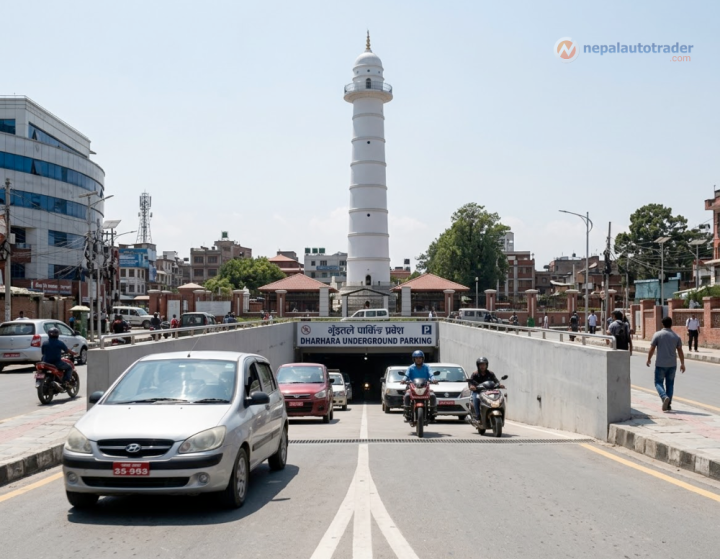
Kathmandu’s traffic grid has long been a bottleneck, especially around the historic Dharhara tower. The city council’s decision on 9 Falgun 2082 to hand the parking operation to the municipal police finally materialises as a concrete solution. Free parking removes a cost barrier that previously forced commuters onto narrow sidewalks, creating a ripple effect on safety and air quality. This matters because every vehicle that clears a curb frees a metre of pedestrian space.
The underground complex is split into three distinct levels:
| Level | Vehicle Type | Capacity |
|---|---|---|
| B‑1 | Four‑wheelers (cars, SUVs) | 127 slots |
| B‑2 | Two‑wheelers (motorcycles, scooters) | ≈ 700 slots |
| B‑3 | Four‑wheelers (cars) | 135 slots (limited by airflow) |
The B‑3 level suffers from inadequate air circulation, meaning the city has capped its usable space at 135 cars until ventilation upgrades are completed. That changes things for future expansion.
KMC’s municipal police are now empowered to issue citations for any vehicle parked on the footpaths or public roads within the following neighbourhoods:
The rule applies to all 32 wards of Kathmandu Metropolitan City. Drivers caught violating the ban will face legal action, a clear signal that the city is serious about reclaiming its streets. This matters for long‑term traffic discipline.
The rollout is a test case for other congested zones in Kathmandu. If the free‑parking model reduces roadside clutter, the city may replicate it in Thamel and Patan Durbar Square.
Free parking alone won’t solve Kathmandu’s chronic congestion, but it creates a controlled anchor point for vehicles entering the historic core. With a reliable underground depot, the municipal police can focus enforcement on illegal street parking rather than chasing every errant driver. In the longer run, the city could integrate digital payment kiosks for optional premium services—reserved spots, EV charging, or car‑wash bays. The current free model is a stepping stone toward a data‑driven mobility ecosystem.
Q: Which vehicles can use the Dharhara underground parking for free? A: All four‑wheelers and two‑wheelers are welcome, provided they fit within the designated slot sizes on B‑1, B‑2 or B‑3. No fee is charged at the gate.
Q: When does the free‑parking policy start? A: The facility opened to the public immediately after the municipal council’s decision on 9 Falgun 2082. Drivers can access it at any time during normal operating hours.
Q: What happens if I park on the street in a targeted ward? A: The municipal police will issue a citation and may impound the vehicle. The city has declared a city‑wide ban on roadside parking for wards 1‑32.
Q: Is there a limit on how long I can stay in the underground lot? A: No explicit time limit has been announced. However, the municipal police reserve the right to enforce reasonable turnover to keep slots available for other drivers.
Q: Will the ventilation issue on B‑3 be resolved? A: The city is evaluating mechanical ventilation upgrades. Until then, B‑3 remains capped at 135 car slots.
Q: How can I find the nearest entrance to the Dharhara facility? A: Entrances are located on the north and south sides of the Dharhara tower. Signage in Nepali and English will guide you from the main road.

Nepal Auto-Trader is one-stop platform for all automotive needs. We provide unbiased and unparalleled news/reviews of all auto-motives being launched in Nepalese Auto-Industry. Find recent updates and price of bikes/cars, compare and review recently launched bikes/cars, buy/sell/trade reconditioned cars/bikes and all government news about changing rules and regulation, road safety by subscribing us.

Subscribe to our Newsletter
© Copyright 2026, Nepal Autotrader



.png)
.png)