

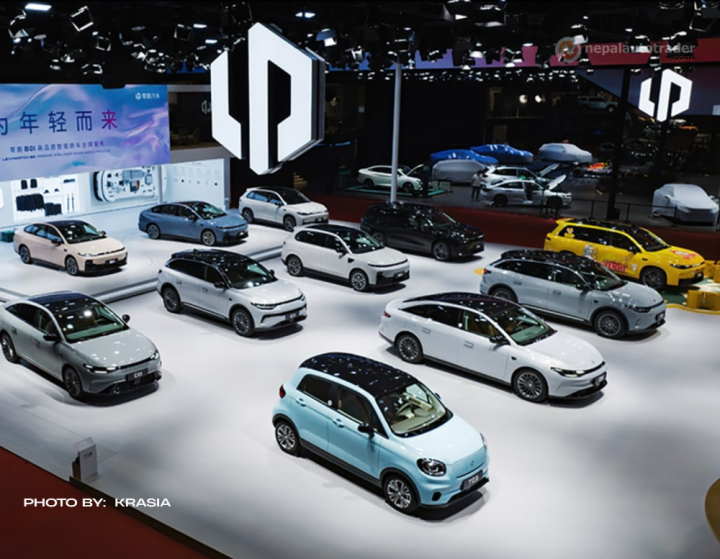
Leapmotor’s publicly released financials show a dramatic swing from loss‑making to profit. The company posted a net profit of $7.83 billion for the calendar year 2025 – a figure that translates to roughly 11 billion 43 million rupees at today’s exchange rate. That matters because no other Chinese EV startup has posted a comparable bottom‑line figure.
The profit surge is directly linked to a 103% increase in total vehicle sales, which rose to 5,96,555 units. Export shipments climbed to 67,052 units, the highest export number among its domestic peers. The revenue jump to 64.73 billion yuan represents a 101.3% year‑over‑year rise.
A gross margin of 14.5% signals that Leapmotor is moving beyond the low‑margin, volume‑only model that has defined many early‑stage EV makers. The margin improvement of 6.1 percentage points over the prior year shows better cost control, higher‑priced models, or both. Cash on hand of 3.78 billion yuan and a positive cash‑flow position the company to fund its aggressive 2026 product rollout without relying heavily on external financing.
FAW Group’s 3.74 billion yuan capital injection at the end of December reshaped the shareholder map. Stellantis, previously the largest external holder, now sits at 18.99%, limiting its influence. That shift could affect future joint‑venture decisions and technology sharing.
Leapmotor’s profit milestone changes the competitive dynamics in China’s EV sector. While legacy giants like BYD and Nio continue to dominate, a profitable startup introduces a new benchmark for scalability and financial health. Smaller players will feel pressure to tighten margins or accelerate sales to stay relevant.
The company’s plan to unveil fresh models across four series – A, B, C, D – in 2026 underscores its ambition. The first A‑10 model is slated for a March 26 launch, positioning Leapmotor to capture both domestic demand and export growth. The target of 10 million vehicles sold in 2026 is audacious; if achieved, it would catapult Leapmotor into the top tier of global EV manufacturers.
Looking ahead, analysts will monitor three key indicators:
The next earnings release, expected in early 2026, should reveal whether Leapmotor can convert its sales surge into a lasting profit engine.
| Metric | 2025 | 2024 |
|---|---|---|
| Net Profit | $7.83 billion | Loss (reported) |
| Revenue | 64.73 billion yuan | ≈32.2 billion yuan |
| Vehicle Sales | 5,96,555 units | 2,93,000 units |
| Export Units | 67,052 units | 38,400 units |
| Gross Margin | 14.5 % | 8.4 % |
| Cash on Hand | 3.78 billion yuan | 2.10 billion yuan |
| Phase | Date | Status / Details |
|---|---|---|
| Profit Announcement | Monday, 5:17 pm, Chait 2, 2082 (NEPALI calendar) | First net‑profit year |
| FAW Investment | December 2025 | 3.74 billion yuan injection |
| New Model Reveal | March 26 2026 | Launch of **A‑10** model |
| 2026 Sales Target | Full year 2026 | ≥10 million vehicles |
The story is still unfolding, but Leapmotor’s 2025 profit marks a turning point for Chinese EV startups. As the company rolls out its next‑generation line‑up, the industry will watch to see whether this profitability can be replicated across a broader product portfolio.
Q: How much profit did Leapmotor record for 2025? A: Leapmotor posted a net profit of $7.83 billion, equivalent to about 11 billion 43 million rupees.
Q: What were the total vehicle deliveries in 2025? A: The company delivered 5,96,555 units, a 103% increase over the previous year.
Q: How many vehicles did Leapmotor export in 2025? A: Exports reached 67,052 units, the highest among Chinese EV startups.
Q: When will the new A‑10 model be launched? A: The A‑10 is scheduled for a public reveal on March 26 2026.
Q: What is Leapmotor’s sales target for 2026? A: Leapmotor aims to sell 10 million vehicles across its four series (A, B, C, D) in 2026.
Q: Which shareholder now holds the largest stake after FAW’s investment? A: FAW Group became the largest external shareholder with a 3.74 billion yuan injection, while Stellantis’ stake fell to 18.99%.

Nepal Auto-Trader is one-stop platform for all automotive needs. We provide unbiased and unparalleled news/reviews of all auto-motives being launched in Nepalese Auto-Industry. Find recent updates and price of bikes/cars, compare and review recently launched bikes/cars, buy/sell/trade reconditioned cars/bikes and all government news about changing rules and regulation, road safety by subscribing us.

Subscribe to our Newsletter
© Copyright 2026, Nepal Autotrader



.png)
.png)