

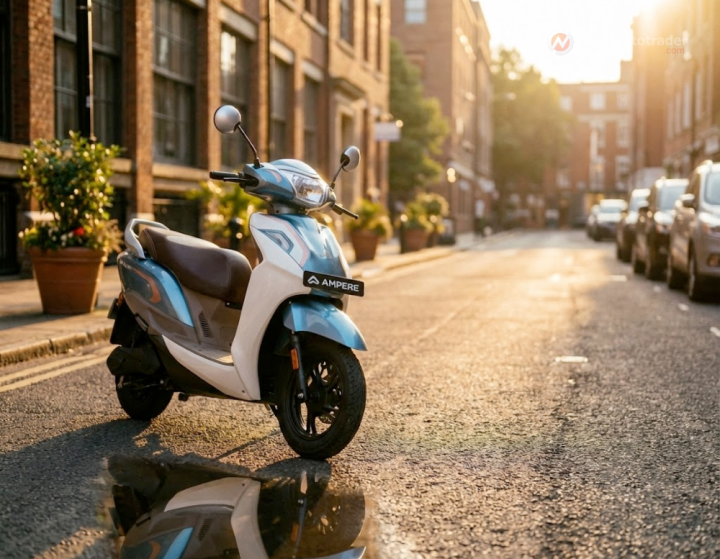
The Indian electric two‑wheel scene just got a new contender. Ampere, a subsidiary of Ashok Leyland, unveiled the Magnus G Max at a low‑key event in Kathmandu before confirming its Indian debut. The scooter is positioned as a budget‑friendly urban commuter, targeting first‑time EV buyers who balk at higher price tags. That matters because price is still the biggest barrier for mass adoption in Tier‑2 and Tier‑3 cities.
The model rolls out with a single‑seat layout, a modest 12‑inch alloy wheel and a drum brake at the rear. The front suspension is a telescopic fork, a small but welcome upgrade over the rigid forks seen on many entry‑level scooters. The combination keeps the ride comfortable on pothole‑strewn streets without adding weight.
At the heart of the Magnus G Max sits a 3 kW lithium‑iron‑phosphate battery pack. Ampere claims the pack can be charged from 20 % to 80 % in 4 hours 30 minutes, a figure that aligns with most Indian home‑charging setups. The scooter’s motor delivers a peak 65 km/h top speed, sufficient for city limits but clearly not aimed at highways.
Three riding modes give the rider flexibility: Eco for maximum range, City for balanced performance, and Reverse to back out of tight spots – a novelty in the Indian market. The display is a 3.5‑inch LCD that shows speed, battery state, and mode selection. A USB charging port lets you top up a phone while on the move, a small convenience that many rivals overlook.
Safety is addressed with a CBS that splits front and rear brake force, improving stability during hard stops. The scooter also sports LED lights for better visibility at night and a drum brake that, while not as strong as a disc, is adequate for the modest weight.
Ampere’s advertised range of 142 km per charge is measured under ideal laboratory conditions. Independent riders in Delhi and Bengaluru have reported a practical range of roughly 100 km before the battery dips into the low‑power warning zone. That gap is typical for electric scooters, where real‑world factors like traffic, rider weight and climate bite into the theoretical numbers.
Charging the LFP pack from a standard 5 A home socket takes just over four hours, meaning a night‑time charge can fully replenish the scooter by morning. The battery’s chemistry offers better thermal stability and a longer cycle life than conventional lithium‑ion packs, which underpins the 5‑year warranty that Ampere is offering – a bold move that could sway cautious buyers.
At ₹94,999 ex‑showroom, the Magnus G Max sits comfortably below the psychological 1‑lakh threshold that has kept many Indian consumers hesitant. Competitors like the TVS iQube start at around ₹1,15,000, while the Bajaj Chetak hovers near ₹1,30,000. This price advantage could translate into higher volume sales, especially in price‑sensitive markets such as Uttar Pradesh, Bihar and Madhya Pradesh.
The scooter’s 33‑litre boot also gives it an edge in practicality. Most city commuters need space for a grocery bag or a small parcel, and the Magnus G Max delivers that without compromising its sleek silhouette. The combination of price, warranty and utility makes it a compelling package.
The Indian electric scooter market is currently expanding at a double‑digit annual rate. Analysts predict that by 2028, electric two‑wheel sales could exceed 3 million units. The entry of a sub‑1‑lakh model could accelerate that growth by pulling in first‑time buyers who previously dismissed EVs as a luxury.
However, infrastructure remains a challenge. While urban centers are seeing a rise in public charging stations, many smaller towns still lack reliable access. Ampere’s reliance on home charging mitigates this to an extent, but the 5‑year warranty may also reassure buyers that the pack will endure even with irregular charging habits.
In the short term, the Magnus G Max will likely carve out a niche among budget‑conscious commuters. In the longer view, its success could push other manufacturers to trim prices or extend warranties, nudging the entire segment toward greater affordability.
Q: What is the exact ex‑showroom price of the Magnus G Max in India?
A: The scooter is priced at ₹94,999 before taxes and registration, keeping it just under the 1 lakh mark.
Q: When will the Magnus G Max be available for purchase?
A: Ampere has announced immediate availability in major Indian metros, with deliveries expected to begin within two weeks of order placement.
Q: How does the Magnus G Max’s range compare to the TVS iQube?
A: Ampere claims up to 142 km on paper, while real‑world tests show about 100 km; the TVS iQube lists a claimed range of 75 km, with similar real‑world figures.
Q: Does the scooter support fast charging?
A: No dedicated fast‑charging protocol is offered; the battery charges from 20 % to 80 % in roughly 4 hours 30 minutes on a standard home socket.
Q: What warranty does Ampere provide on the battery?
A: A 5‑year warranty covers the LFP battery pack against capacity loss beyond the manufacturer’s stipulated limits.
Q: Are there any government subsidies applicable?
A: Buyers may be eligible for state‑level EV incentives, but the amount varies by region and must be confirmed with local authorities.
PREVIOUS NEWS
NEXT NEWS

Nepal Auto-Trader is one-stop platform for all automotive needs. We provide unbiased and unparalleled news/reviews of all auto-motives being launched in Nepalese Auto-Industry. Find recent updates and price of bikes/cars, compare and review recently launched bikes/cars, buy/sell/trade reconditioned cars/bikes and all government news about changing rules and regulation, road safety by subscribing us.

Subscribe to our Newsletter
© Copyright 2026, Nepal Autotrader



.png)
.png)