

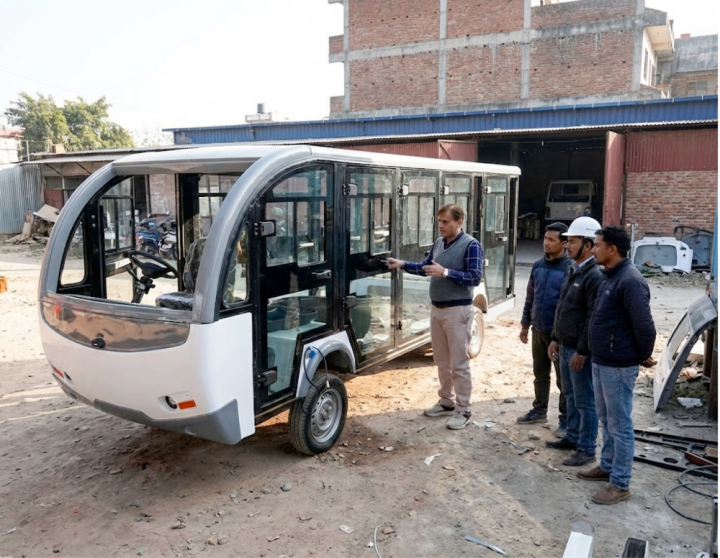
Locally assembled Made in Nepal electric bus from Sundar Auto Engineer had its public debut today on 8th Feb 2026
Designed as 11 seater and 14 seater electric public transport targeting safer alternatives to three wheelers
Road testing planned on Kathmandu streets ahead of official launch
Supports Nepal’s push toward affordable EV mobility and locally produced electric vehicles
Built on experience from Sundar Yatayat’s electric transport operations and charging network
Aims to reduce reliance on imported microbuses and strengthen domestic EV manufacturing
Project aligns with Nepal’s growing demand for best selling EV public transport and low emission mobility
Nepal’s electric mobility story is entering a new chapter. Instead of relying solely on imported buses and vans, a Made in Nepal electric bus is preparing to hit Kathmandu’s streets. Built by Sundar Auto Engineer, the locally assembled EV is not just another vehicle launch. It signals a shift toward domestic manufacturing, safer public transport, and affordable EV solutions tailored to Nepal’s urban mobility challenges.
The project focuses on compact electric public transport vehicles with 11 and 14 seat configurations, targeting city commuting needs where microbuses dominate today.
Nepal’s EV market is booming, driven by rising fuel costs, urban pollution concerns, and supportive government incentives. Most public transport EVs currently come from foreign brands. Local assembly is still rare.
Strong growth in EV adoption across passenger vehicles and public transport
Heavy reliance on imported electric vans and buses
Growing demand for safer alternatives to three wheelers and aging microbuses
Expansion of charging infrastructure by private operators
Sundar Auto Engineer’s project stands out because it aims to localize production and reduce import dependency. The company has prior experience running electric buses and building charging stations in Nepal, giving it operational credibility.
Official technical specifications remain limited as the vehicle is still in pre launch testing. However, key details revealed so far provide insight into positioning.
| Category | Details |
|---|---|
| Vehicle Type | Four wheel electric public transport |
| Seating Capacity | 11 seater and 14 seater variants |
| Assembly | Locally assembled in Nepal |
| Use Case | Urban passenger transport |
| Launch Stage | Road testing phase |
| Target Segment | Affordable EV public transport |
Designed to replace unsafe or unregulated three wheelers
Compact size suitable for Kathmandu’s dense traffic
Focus on safety and structured passenger mobility
Built with local assembly expertise and operational experience
The Made in Nepal electric bus is not chasing luxury. It is built for practicality and urban mobility.
Lower operating costs compared to diesel or petrol microbuses
Potentially lower acquisition costs through local assembly
Reduced emissions supporting Nepal’s clean energy goals
Better safety compared to informal public transport options
Strong potential to become a best selling EV in microbus category
If production scales successfully, local manufacturing could also create jobs and reduce foreign currency outflow on vehicle imports.
The new locally assembled EV enters a space currently dominated by imported electric microvans and small buses.
| Feature | Made in Nepal Electric Bus | Imported Electric Microbus | Imported Luxury Electric Bus |
|---|---|---|---|
| Manufacturing | Local assembly | Fully imported | Fully imported |
| Target Use | Urban short routes | Urban commuter | Premium intercity |
| Price Positioning | Affordable EV | Mid range | High cost |
| Market Impact | Local manufacturing boost | Established market presence | Limited premium niche |
| Key Advantage | Domestic production | Proven reliability | High capacity and range |
Imported luxury EV buses offer higher power and longer range, often around 300 km per charge, but target premium segments rather than daily microbus routes.
Nepal’s first locally assembled electric bus is more than a transport solution. It is a strategic move toward building a domestic EV ecosystem. With road testing imminent, Sundar Auto Engineer is positioning itself as a pioneer in localized electric mobility.
If the project scales and achieves competitive pricing, it could reshape Nepal’s public transport market by offering an affordable EV alternative tailored to local conditions. The bigger impact lies beyond one vehicle. It could accelerate Nepal’s transition from an EV importer to a producer, redefining how urban mobility evolves in the country.
The next milestone will be successful testing, followed by commercial rollout and potential expansion into larger locally assembled buses. If demand holds, this homegrown EV could become a blueprint for Nepal’s future in sustainable transport.

Nepal Auto-Trader is one-stop platform for all automotive needs. We provide unbiased and unparalleled news/reviews of all auto-motives being launched in Nepalese Auto-Industry. Find recent updates and price of bikes/cars, compare and review recently launched bikes/cars, buy/sell/trade reconditioned cars/bikes and all government news about changing rules and regulation, road safety by subscribing us.

Subscribe to our Newsletter
© Copyright 2026, Nepal Autotrader



.png)
.png)