

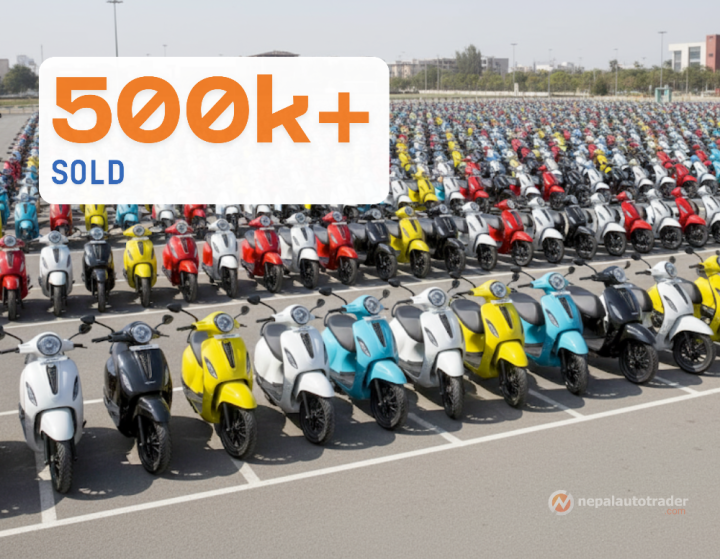
Just a few days ago, Bajaj Auto announced that the Bajaj Chetak electric scooter has crossed the 500,000-unit sales mark worldwide. The achievement cements Chetak as one of the most successful electric two-wheelers in the market, proving that EV adoption is no longer a distant dream it’s happening right now.
510,000+ units sold globally as of August 2025
FY 2025 sales more than doubled compared to FY 2024
88,000+ units sold in the first five months of FY 2026
Nepal price: NPR 325,000, positioning Chetak in the premium EV scooter category
Competition: Ola S1, TVS iQube, and Hero Electric scooters
The sales journey of the Chetak shows how quickly the scooter has scaled up after its initial years.
| Period | Units Sold | Key Milestone |
|---|---|---|
| Jan 2020 – Launch | — | Chetak reintroduced as an EV |
| Nov 2023 | 100,000 | First major benchmark |
| FY 2024 | 115,702 | Stable growth |
| FY 2025 | 260,033 | Sales doubled year-over-year |
| Apr–Aug 2025 (FY 2026) | 88,218 | Strong start to the fiscal year |
| Aug 2025 | 510,000+ | Global sales milestone achieved |
Takeaway: It took Chetak nearly three years to reach 100,000 sales but less than two years to add another 400,000.
Several factors explain why the Chetak has crossed the half-million mark so quickly:
Heritage appeal: A trusted brand name revived with modern EV technology.
Lower running costs: Electricity is far cheaper than petrol; maintenance needs are minimal.
Government incentives: Subsidies and tax breaks make the scooter more affordable.
Charging convenience: Home charger installations and growing public infrastructure reduce range anxiety.
Proven reliability: Bajaj’s wide service network ensures support and spare parts availability.
Like every EV, the Chetak faced hurdles in its early phase. Bajaj tackled them through:
Battery worries → Extended warranties and advanced battery management systems
High upfront cost → Financing options and government subsidies
Charging limitations → Partnerships for public chargers + home installation support
Consumer hesitation → Emphasis on premium build quality and test-ride availability
In Nepal, the Bajaj Chetak is sold at NPR 325,000 through Hansraj Hulaschand & Co. Pvt. Ltd.
Target buyers: Urban professionals and daily commuters looking for reliable, stylish EVs
Market reception: Premium positioning but strong interest due to fuel savings and lower lifetime costs
Growth potential: Rising adoption in Kathmandu, Lalitpur, and Pokhara as EV infrastructure expands
Bajaj isn’t stopping at 5 lakh sales. The company is likely to focus on:
Longer battery range to support longer commutes
Faster charging solutions including DC fast charging compatibility
Smart integrations such as GPS, Bluetooth dashboards, and app-based controls
Market expansion across Southeast Asia and Africa
Cost efficiency as production scales up further
The 5 lakh sales milestone for Bajaj Chetak marks a turning point in the electric two-wheeler market. For buyers, it signals that:
EVs are now mainstream, not experimental
Operating costs are far lower than petrol scooters
Premium EVs like Chetak set the benchmark for reliability and performance
With the fire of skepticism largely under control, the Bajaj Chetak is proving that the future of mobility is electric—and it’s already here.

Nepal Auto-Trader is one-stop platform for all automotive needs. We provide unbiased and unparalleled news/reviews of all auto-motives being launched in Nepalese Auto-Industry. Find recent updates and price of bikes/cars, compare and review recently launched bikes/cars, buy/sell/trade reconditioned cars/bikes and all government news about changing rules and regulation, road safety by subscribing us.

Subscribe to our Newsletter
© Copyright 2026, Nepal Autotrader



.png)
.png)